
English Language and Culture – French Language and Culture
(full time, bachelor degree)
Graduate profile
English Language and Culture
Graduates of the Bachelor’s degree program in English Language and Culture possess extensive theoretical and methodological knowledge regarding the language—including its grammar, lexicon, and theory—as well as the history and evolution of translation, literature, and the cultural context of English-speaking countries. They can find employment in translation agencies, cultural institutions, non-profit NGOs, and companies focused on international cooperation. Having mastered the fundamentals of consecutive interpreting, they are also qualified to work as interpreters in less demanding communicative situations (such as tour guiding, service provision, and workplace communication, or—in exceptional cases—public service interpreting).
French Language and Culture
Graduates of the French Language and Culture study program (at the first level of higher education, taken in combination with another subject) will enhance their practical receptive and productive language skills and acquire key knowledge—grounded in an understanding of broader contexts—regarding the language, history, culture, literature, and societal realities of France and Francophone countries. They will also gain fundamental knowledge and skills in the fields of translation studies, translation methodology, and interpreting (understanding the factors involved in the translation process through both intratextual and extratextual analysis, and mastering the basic strategies, methods, and techniques used to translate and interpret from the source language to the target language).
Graduates of this program are qualified to work in less demanding cross-linguistic mediation contexts (providing basic interpreting services). They are capable of handling routine translation tasks, administrative work, and correspondence, as well as translating texts of moderate complexity.
Acceptance conditions
English Language and Culture – no entrance exam
Admission to this programme requires English language proficiency at the B2 level or higher according to the Common European Framework of Reference for Languages.
Applicants’ fulfilment of the admission requirements will be assessed on the basis of: (I) their average year-end mark from years 1–3 of their secondary education and (II) their average mark for their English course in years 1–3 of secondary school, both of which applicants must state in their application.
Applicants are ranked on a percentage scale. For the first criterion, applicants can earn up to 60 percentage points; for the second, 40 percentage points. 20 bonus points are given to applicants who submit any of the following credentials (scanned and attached to their electronic application):
– University of Cambridge ESOL Examinations, Certificate in Advanced English
– University of Cambridge ESOL Examinations, Certificate of Proficiency in English
– University of Cambridge ESOL Examinations, First Certificate in English – score A
– IELTS – International English Language Testing System – minimum level 6.5
– secondary-school-leaving exam on the English language
• level C1 – final result “excellent” (A) or “very good” (B)
• level B2 – external portion minimum 65% mark + oral portion result “excellent” (A) or “very good” (B)
– a certificate of completion of secondary-school studies from an English bilingual section of a gymnasium
French Language and Culture – no entrance exam
French language proficiency at the A2 level or higher according to the Common European Framework of Reference for Languages is a prerequisite for translation programmes in French Language and Culture in every programme combination.
Applicants’ fulfilment of the admission requirements will be assessed on the basis of their average year-end mark from years 1–3 of their secondary education, which applicants must state in their application.
Applicants are ranked on a percentage scale. For their average mark, applicants can earn up to 100 percentage points. 20 bonus points are given to applicants who submit any of the following credentials (scanned and attached to their electronic application) that demonstrate French proficiency at the A2 level or higher:
‒ an internationally recognized DELF or DALF French language diploma
‒ secondary school leaving examination in the French language – level B1
‒ a certificate of completion of secondary-school studies from a French bilingual section of a gymnasium
‒ a French-language-proficiency certificate issued by a language school included in the network of schools and educational institutions of Slovakia’s Ministry of Education, Research, Development and Youth (registered public language schools: https://www.cvtisr.sk/buxus/docs/JH/stat_zus.pdf and private language schools: https://www.cvtisr.sk/buxus/docs/JH/sukromne_sasz.pdf) or by a foreign institution authorized to issue French-language-proficiency certificates
This programme also requires Slovak language proficiency at the B2 level or higher according to the Common European Framework of Reference for Languages, demonstrated by a certificate of Slovak language proficiency.
Information for foreign students
Basic admission requirements for foreign applicants to bachelor’s studies:
‒ completed secondary education or secondary vocational education with a school-leaving-exam certificate, demonstrated with a clause confirming the recognition of their attained education level, as well as a certified copy of their secondary-school-leaving-exam certificate or a notarized copy of the decision to recognize their education credential (school-leaving-exam certificate) issued by the regional school administration office (a document called nostrifikácia in Slovak)
Applicants for bachelor’s studies who have completed their secondary education in an EU country (besides Czechia, as Czech education credentials do not need to be officially recognized), Norway, Switzerland, Liechtenstein, the United Kingdom, Ukraine, Russia, China, or Iceland must include the clause confirming the recognition of their level of education in paper form along with a certified copy of their education credential (school-leaving-exam certificate) and a sworn (certified) translation of it into Slovak. Information on acquiring and using a clause confirming the recognition of foreign education credentials can be found at the website of Slovakia’s Ministry of Education, Research, Development and Youth (https://uznavanie.minedu.sk/en/category/recognition-statement).
Applicants for bachelor’s studies who have completed their secondary education in a country that does not have a recognition clause with Slovakia must send the original or a notarized copy of the decision to recognize their education credential (school-leaving-exam certificate) attained outside Slovakia. Decisions to recognize foreign secondary-education credentials are issued by the regional school administration office in the regional seat where the applicant permanently resides or by the Regional School Administration Office in Banská Bystrica.
(https://uznavanie.minedu.sk/en/category/recognition-of-secondary-education).
If an applicant for bachelor’s studies who has completed their secondary education abroad does not, by the specified deadline, deliver the clause recognizing their education credential with the required attachment or the original/notarized copy of the decision recognizing their education credential and/or does not, by the specified deadline for admission requirement fulfilment verification, deliver the Slovak-language-proficiency certificate at the required level, they will be accepted conditionally. Applicants must present these documents by the day of enrolment at the latest.
Application fees
Application fee: 30,00 €
Online application fee: 30,00 €
General information about the entrance exam
General information on the admissions process
For all applicants, the admissions process begins by submitting an application. Applicants may apply for multiple programmes, but they must submit a separate application for each programme. There is no limit on the number of submitted applications per applicant. Applications are submitted electronically via the central web-based application system. The Faculty of Arts will accept electronic applications with or without validated electronic signatures.
The application must include:
‒ the applicant’s CV
‒ a notarized copy of the applicant’s secondary-school-leaving exam certificate (applies to applicants for bachelor’s programmes who have completed secondary school)
‒ a certificate of fitness from a doctor (applies to the bachelor’s programmes Teaching of English Language and Literature & Teaching of Physical Education; Teaching of German Language and Literature & Teaching of Physical Education; Teaching of Russian Language and Literature & Teaching of Physical Education)
‒ a certificate of proficiency in Slovak as a foreign/second language at the required level (at least B1, except in the programmes in the field of study Philology and the interdisciplinary programmes that include it, as well as master’s teaching programmes, where the minimum level is B2) issued by a language school included in the network of schools and educational institutions of Slovakia’s Ministry of Education, Research, Development and Youth (registered public language schools: https://www.cvtisr.sk/buxus/docs/JH/stat_zus.pdf and private language schools: https://www.cvtisr.sk/buxus/docs/JH/sukromne_sasz.pdf), a higher-education institution in Slovakia that coordinates or administers language and academic preparation for tertiary study, or by the testing organization Scio – required for foreign applicants to bachelor’s programmes (except for applicants to the programme Slovak for the Linguistic and Cultural Competence of International Students).
‒ attachments specifically required for the programme Slovak for the Linguistic and Cultural Competence of International Students
Electronic applications must include scans of all required documents (with stamps and signatures clearly visible) as attachments. After the form is completely filled in and all the attachments have been added, the applicant must confirm the application. The complete and confirmed electronic application will only be considered submitted after the application fee has been paid.
After submitting their application, applicants for bachelor’s studies who have completed their secondary-school education in Slovakia or Czechia must also deliver, by post or by hand, a notarized copy of their secondary-school-leaving-exam certificate to the faculty study department by 13 June 2027.
Applicants who do not present proof of having completed secondary education or secondary vocational education by the given deadline will be accepted conditionally. Applicants must present a notarized copy of a secondary-school-leaving-exam certificate by the day of enrolment at the latest; otherwise, they cannot enrol as a student.
Basic admission requirements for bachelor’s studies:
‒ completed secondary-school education or secondary vocational education with a school-leaving-exam certificate
Menu
- Academic year: 2027/2028
- Estimated number of accepted: 15
- Years of study: 3
- Language: English, French, Slovak
- Admission procedure date: 03.05.2027 - 04.06.2027
- Online application deadline: 01.11.2026 - 30.04.2027
- Special needs coordinator: PhDr. Kamila Koza Beňová, PhD. (office no. F326);
048/446 7326;
e-mail: [email protected]
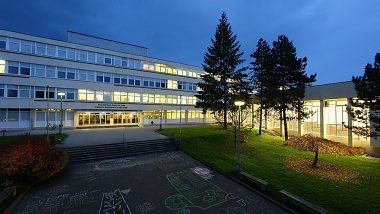
Faculty of Arts
Tajovského 40
974 01 Banská Bystrica
tel. +421-48-446 71 11
fax: +421-48-413 61 53
http://www.ff.umb.sk